



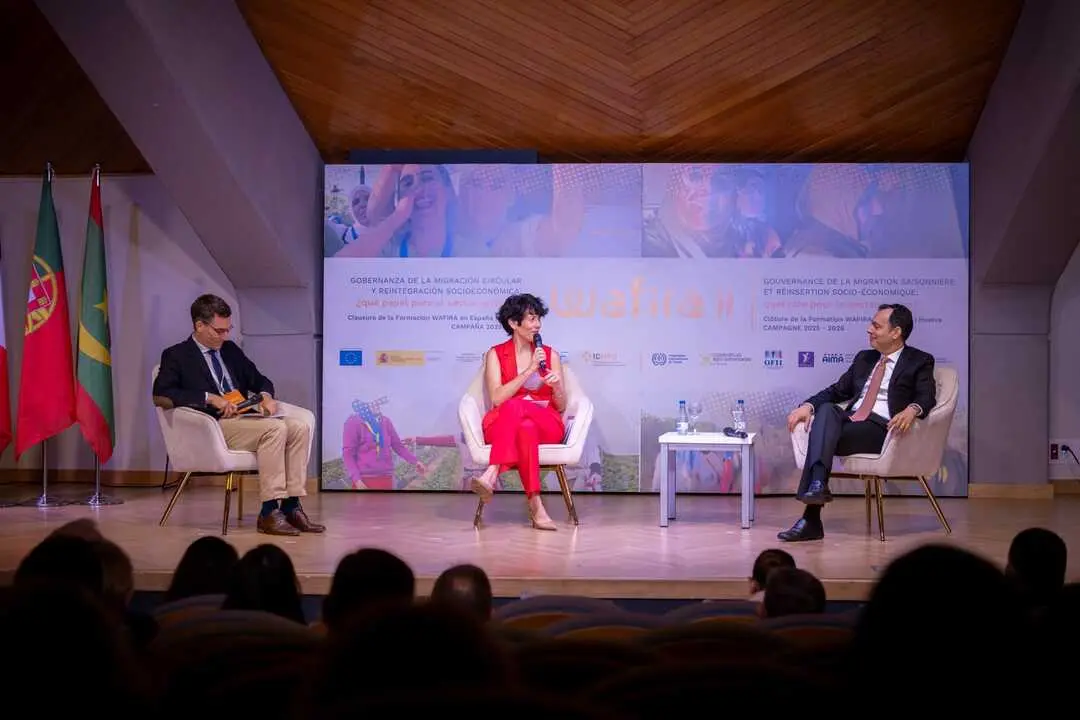

Morocco’s Minister of Economic Inclusion, Small Business, Employment and Skills, Younes Sekkouri, presented Morocco’s human-centered approach to migration governance during a forum held in Huelva, Spain, emphasizing solidarity, shared responsibility and respect for human dignity.
Speaking at the forum titled “Migration Governance and Circular Migration between Morocco and Spain: Keys to Mutually Beneficial Cooperation,” Sekkouri said Morocco’s migration policy is guided by the High Directives of His Majesty King Mohammed VI, placing human capital at the heart of public policies and viewing mobility as a driver of economic growth, skills transfer and stronger ties between nations.
The minister stressed that this vision has enabled Morocco to establish itself as a regional and international reference in migration governance.
He also highlighted the strategic partnership between Morocco and Spain, supported by a robust institutional framework that includes the 2001 bilateral agreement, the 2009 and 2023 memorandums, and the 2025 Declaration of Intent. These instruments have strengthened circular migration as a cornerstone of bilateral cooperation.
Sekkouri underlined the role of his ministry in developing qualified mobility pathways aligned with Morocco’s National Employment Strategy and regional development priorities.
According to the minister, the Moroccan-Spanish experience demonstrates that effective migration governance relies on political vision, strong institutions, technical cooperation, labor mobility and territorial development, making it a benchmark for Euro-Mediterranean cooperation.
Spanish Minister of Inclusion, Social Security and Migration Elma Saiz described migration cooperation between Morocco and Spain as a valuable reference model, praising institutional and public-private collaboration in managing labor mobility.
She also highlighted the positive impact of the Wafira program, which supports Moroccan seasonal workers in Huelva’s red fruit sector through entrepreneurship training. During the 2025–2026 agricultural campaign, Wafira II provided entrepreneurial training to 225 Moroccan seasonal workers using the International Labour Organization’s GET Ahead methodology.
Running from 2025 to 2028, the project aims to support 3,000 Moroccan seasonal workers across Europe while helping 300 beneficiaries launch their own income-generating businesses.