

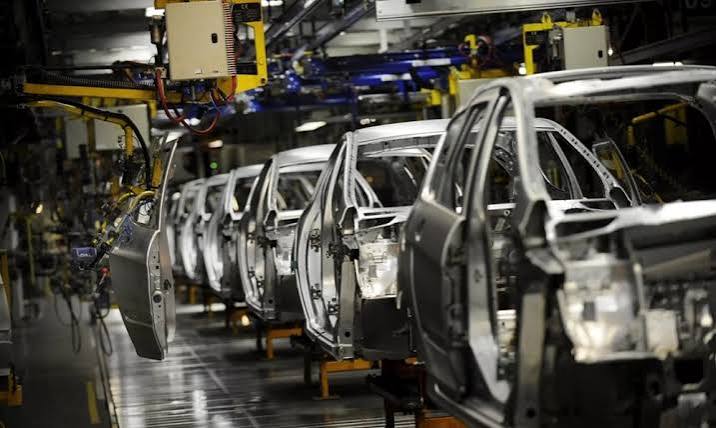
Morocco is gaining a clear lead in the Maghreb automotive race. With 559,645 vehicles produced in 2024, more than 250,000 direct jobs, nearly MAD 196 billion in turnover and industrial capacity expected to exceed one million vehicles in the medium term, the Kingdom is entering a new phase of automotive industrial development. Renault and Stellantis are strengthening an ecosystem increasingly focused on exports, local integration and higher value-added activities.
Morocco: an export-oriented automotive industrial powerhouse
According to OICA data, Morocco produced 559,645 vehicles in 2024, compared with 535,825 in 2023, representing an increase of around 4.4%. Production included 524,467 passenger cars and 35,178 commercial vehicles.
Renault remains the leading industrial player. In 2024, the group produced 413,614 vehicles in Morocco, including 312,381 at the Tangier plant and 101,233 in Casablanca. Around 90% of this production is exported. The Tangier plant employed approximately 6,230 people in June 2026 and produces models including the Dacia Sandero, Dacia Jogger and Renault Express.
Stellantis is also expanding its industrial footprint. Its Kenitra investment program exceeds MAD 3 billion, with around 2,000 jobs associated with the expansion. The site has an initial production ambition of around 450,000 vehicles per year, while the group has also announced more than €300 million to double capacity and develop a new platform.
The Kenitra ecosystem is also moving beyond conventional vehicle production. Engine production capacity has reached 350,000 units per year, while production of electric micromobility vehicles — Citroën Ami, Opel Rocks-e and Fiat Topolino — increased from 20,000 to 70,000 units per year from January 2025.
The Moroccan automotive sector now accounts for more than 250,000 direct jobs and nearly MAD 196 billion in turnover. The Casablanca-Settat region alone brings together around 250 automotive companies and 220,000 jobs, supported by eight industrial ecosystems.
Local integration is also strengthening. Renault’s local sourcing rate has reached 65.5%, compared with 88 local suppliers in 2026 versus 26 in 2016. The group is targeting a local integration rate of 80% by 2030.
Algeria: rebuilding an automotive industry around Fiat and local integration
Algeria is seeking to rebuild its automotive industry after several years of uncertainty. The Fiat plant in Tafraoui, near Oran, represents the main industrial anchor of this strategy. Stellantis initially committed more than €200 million to the project. Production increased from 17,000 vehicles in 2024 to 53,000 in 2025, with a target of 90,000 units in 2026 and approximately 135,000 vehicles per year by 2028.
Additional investment is expected to generate more than 1,000 direct and indirect jobs. The initial program also envisaged around 2,000 direct jobs in 2026 and more than 1,600 indirect positions. Fiat locally produces the Fiat 500, Doblò and Grande Panda, while the authorities are seeking to increase the level of local integration, targeted at more than 35% in 2026.
The Algerian strategy is also opening up to Chinese manufacturers. Chery has announced agreements relating to local production and subcontracting, potentially expanding the country’s industrial base.
Algeria therefore has significant industrial potential, but its automotive ecosystem remains less mature than Morocco’s, particularly in terms of supplier density, export orientation and integration into global automotive value chains.
Egypt: the largest market, with a growing localization strategy
With a population exceeding 100 million, Egypt is the largest automotive market in North Africa. Its strategy is therefore primarily based on combining domestic demand, vehicle assembly and increasing local content.
According to OICA, Egypt produced 36,640 vehicles in 2024, including 9,970 passenger cars and 26,670 commercial vehicles.
The National Automotive Industry Development Program aims to increase domestic production and progressively raise local content. The authorities are targeting a 60% local-content rate by 2032.
At least 12 international manufacturers are active or involved in the Egyptian automotive industry, including General Motors, Nissan, Toyota, Stellantis and several Chinese manufacturers.
Yazaki has invested around €30 million in a wiring-harness plant in Fayoum, creating more than 3,000 direct and indirect jobs and targeting annual exports of around €100 million.
Nissan Egypt has invested approximately $276 million, while the Arab Organization for Industrialization is producing the Citroën C4X with a local integration rate of around 45%, at an estimated production volume of approximately 7,000 vehicles per year over four years.
Stellantis is also preparing the production of a new model from the end of 2026, with a cumulative production target of 240,000 vehicles.
The Egyptian market recorded a sharp recovery in 2025. Automotive sales reached 173,763 vehicles, compared with 102,249 in 2024, representing an increase of around 70%. Passenger cars accounted for 133,973 units. Nissan held approximately 19.2% of the market, followed by Chery-Ghabbour at 13.9% and MG at 12.4%.
Tunisia: a major platform for automotive components
Tunisia has developed a different automotive model, based primarily on components, wiring systems, electronics and exports to European markets. According to the Tunisian Investment Authority, the automotive industry provides more than 80,000 jobs, contributes around 4% of GDP and generated more than €1.5 billion in automotive exports in 2023.
The country benefits from a substantial technical and engineering base, with 47 engineering schools, 25 technological institutes and more than 60 vocational training centers. Major international groups operating in Tunisia include COFICAB, Leoni, Visteon and Zodiac Automotive. Leoni alone employs around 16,500 people in the country.
Visteon invested approximately $50 million in its Borj Cedria operations in 2024, with more than 400 additional jobs created. The company could eventually reach around 1,000 direct and 3,500 indirect jobs by 2028.
Another automotive project in Bizerte represents an investment of around TND 300 million, with more than 3,000 jobs expected by 2028.
According to the Tunisian Automotive Equipment Manufacturers Association, the country now has more than 280 automotive companies, employing over 120,000 people and generating approximately €3.9 billion in exports.
Four countries, four different industrial models
The Maghreb and North African automotive industry is therefore developing along four distinct models. Morocco has opted for integrated vehicle production, exports and industrial ecosystems. Algeria is rebuilding its automotive industry around Fiat, Chery and the gradual development of local suppliers. Egypt is relying on its huge domestic market while increasing local production and localization. Tunisia has specialized in automotive components, electronics, wiring systems and exports to European manufacturers.
This divergence is reflected in production volumes, industrial infrastructure, supplier networks and the degree of integration into international value chains.
Brands and models: Morocco takes the lead
Morocco’s automotive production is dominated by Renault and Dacia, with Stellantis adding Peugeot, Opel, Citroën and other brands to the ecosystem.
In 2025, Dacia registered more than 47,000 vehicles, while Renault recorded around 41,000 units. Peugeot reached approximately 16,372 vehicles, while Opel recorded around 8,967 units. Algeria’s locally manufactured range is centered on Fiat, particularly the 500, Doblò and Grande Panda, with Chery preparing to strengthen its industrial presence. Egypt has a broader market structure, with Nissan, Chery and MG among the leading brands in 2025, alongside Toyota, Hyundai, General Motors and Stellantis.
Tunisia remains primarily focused on components, although the local market also features international brands. Kia registered around 7,038 passenger vehicles in 2025 and ranked among the leading brands in the Tunisian market.
Morocco’s decisive competitive advantage
Morocco’s advantage does not simply lie in the number of vehicles produced. It is based on the combination of several strategic factors: export orientation, Tanger Med, industrial infrastructure, two major global manufacturers, a dense supplier network, specialized industrial zones and numerous trade agreements.
The country has gradually moved from an assembly model toward a more integrated industrial ecosystem involving engines, components, wiring, electronics, plastics, batteries, logistics and engineering.
The presence of Renault and Stellantis provides Morocco with two global industrial anchors, while the growing network of local and international suppliers strengthens the country’s ability to capture a larger share of automotive value chains.
The Casablanca-Settat and Tangier-Tetouan-Al Hoceima regions are at the heart of this industrial transformation, supported by logistics platforms, ports, free zones, highways and rail infrastructure. The country’s industrial capacity could reach up to two million vehicles per year by 2030, depending on the implementation of announced and planned investments.
The next battle: electric vehicles, batteries and advanced technologies
The next stage of competition will not be limited to conventional vehicle production. The strategic priorities are increasingly shifting toward electric vehicles, batteries, power electronics, automotive software, advanced driver-assistance systems, artificial intelligence and high-value-added components.
Morocco is already positioning itself in these emerging segments, particularly through investments connected with electric mobility, battery materials and the broader automotive ecosystem.
Algeria is seeking to accelerate industrial integration through local production and supplier development. Egypt is relying on its domestic market to attract new production programs, while Tunisia is consolidating its position as a component and electronics platform for European manufacturers.
A widening gap in industrial maturity
The comparison between the four countries reveals a clear difference in industrial maturity. Morocco currently stands out as the only one of the four countries combining large-scale vehicle production, two global automotive manufacturers, a dense supplier ecosystem, substantial local integration, modern logistics infrastructure and a strongly export-oriented industrial strategy.
Egypt has the strongest domestic market. Tunisia has considerable expertise in components and electronics. Algeria has significant industrial potential and a large domestic market.
But Morocco has managed to connect these different elements into a coherent industrial system. The Maghreb automotive race is therefore entering a new phase. The challenge is no longer simply to assemble vehicles, but to control an increasing share of the value chain.
On this front, Morocco currently has a significant lead, while Algeria, Egypt and Tunisia are pursuing complementary strategies to strengthen their respective positions in the regional automotive industry.