



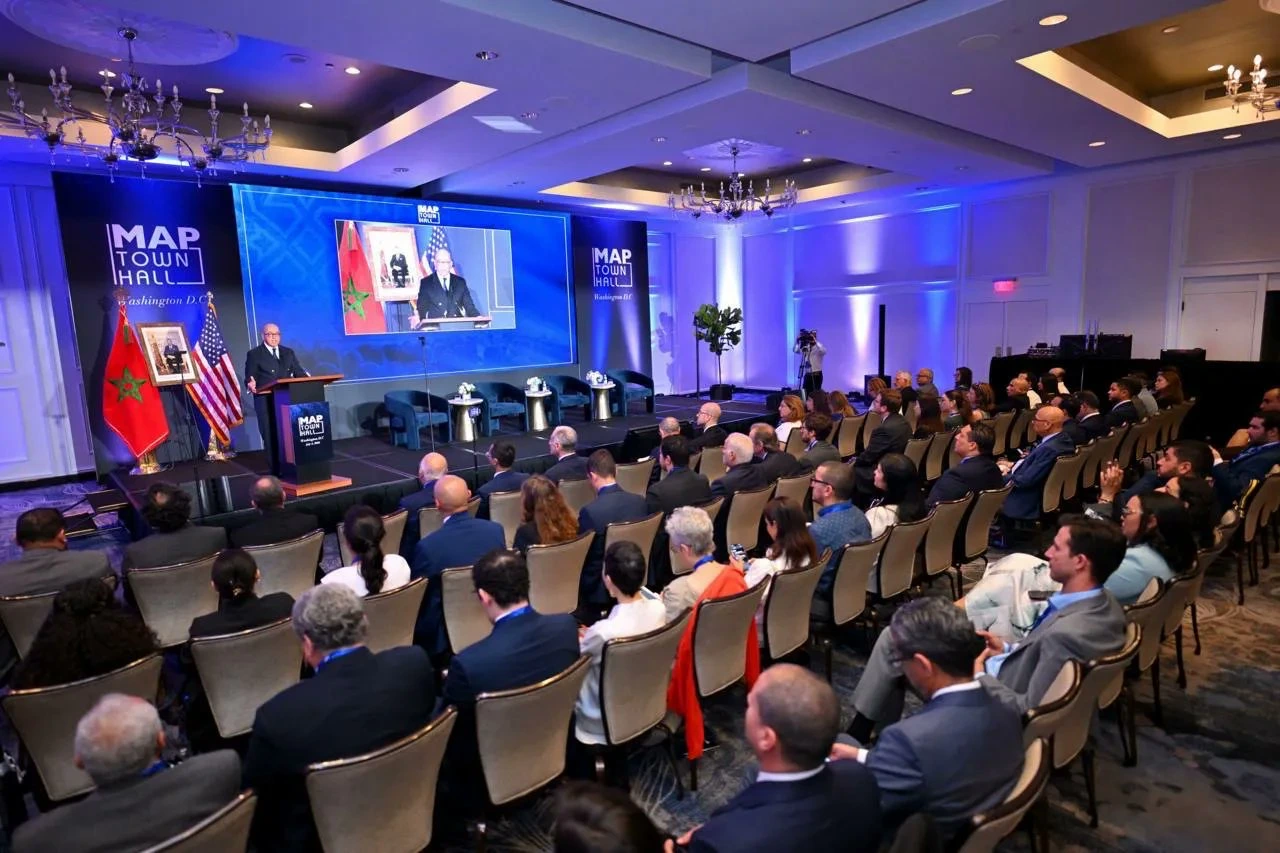
The bipartisan consensus in the United States around its strategic partnership with the Kingdom of Morocco is not a recent development, but one that dates back to the very founding of the American Republic, according to panelists speaking at the first international edition of the MAP Town Hall held in Washington.
Examining the historical roots of this longstanding relationship, which has evolved into a deep strategic alliance strengthened over time, speakers highlighted the enduring diplomatic ties between Rabat and Washington and their continued relevance in today’s geopolitical context.
Former ambassador and Atlantic Council senior fellow Peter Pham noted that the 1786 Treaty of Peace and Friendship between Morocco and the United States—signed by John Adams and Thomas Jefferson—represents one of the earliest diplomatic foundations of the young American nation. Despite their political differences, both founding figures agreed on the importance of establishing formal relations with Morocco, setting the stage for what has become the longest uninterrupted diplomatic relationship in U.S. history.
According to Pham, this historical reality underscores the depth of bipartisan consensus in the United States regarding its partnership with Morocco, a consensus that, he argued, has existed since the earliest days of American independence.
He further emphasized that the Morocco–U.S. relationship has evolved beyond diplomacy into a comprehensive strategic alliance focused on peace, security, stability, and co-development, particularly in Africa.
In this context, he highlighted Morocco’s key initiatives on the continent, including the Atlantic Initiative for the Sahel States and the Atlantic African States Process, both launched under the leadership of His Majesty King Mohammed VI. These initiatives aim to promote regional integration and sustainable development across Africa.
Former U.S. Envoy to the Great Lakes and Sahel region Ilan Berman also underlined the shared values and opportunities that define the Morocco–U.S. relationship, describing it as a model partnership both regionally and globally.
He stressed Morocco’s strategic role as a bridge between the United States and Africa, pointing to its commitment to development projects and high-value economic initiatives across the continent.
The MAP Town Hall, themed “Kingdom of Morocco – United States of America: From a Historical Partnership to a Strategic Alliance,” took place in a context of renewed strategic momentum in relations between Rabat and Washington.
The event brought together political, diplomatic, academic, cultural, and media figures, as well as representatives of influential think tanks, to explore the past, present, and future of the Morocco–U.S. alliance.