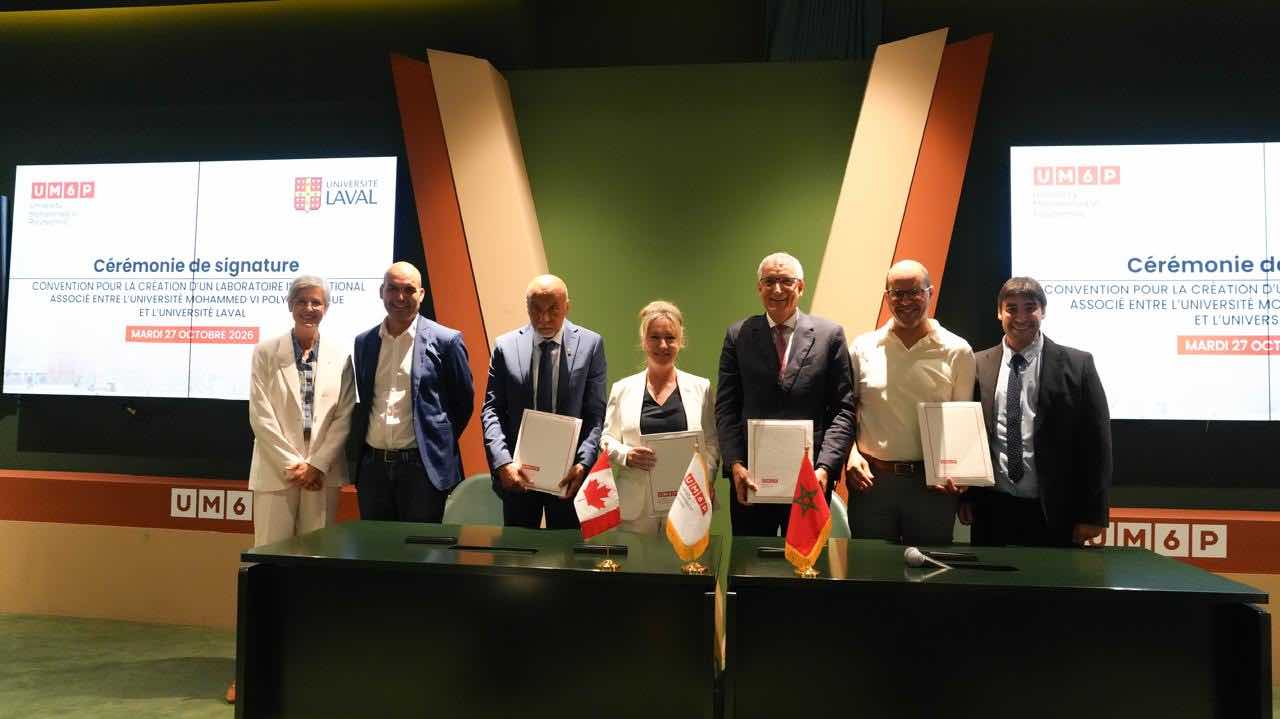
Scientific cooperation between Morocco and Canada is entering a new phase following the signing of two strategic agreements between Mohammed VI Polytechnic University (UM6P) and Canada’s Université Laval in Benguerir. The partnership includes the establishment of an international joint research laboratory bringing together physics, optics, neuroscience, and oncology. This initiative aims to strengthen academic cooperation, accelerate innovation in medical diagnostics and treatments, and consolidate Morocco’s position within international scientific research networks, supporting its ambition to develop a healthcare ecosystem driven by knowledge, advanced technologies, and precision medicine.
Morocco continues to strengthen its position in scientific research and medical innovation by expanding partnerships with leading international universities. This strategy seeks to develop national scientific expertise, facilitate knowledge and technology transfer, and establish stronger connections between academic research, healthcare needs, and industrial development.
 Against this backdrop, Mohammed VI Polytechnic University and Université Laval signed two scientific and academic cooperation agreements on October 27, 2026, at UM6P’s campus in Benguerir, during the official visit to Morocco of Sophie D’Amours, Rector of Université Laval.
The agreements mark a new milestone in a partnership established in 2018, which has progressively evolved into a broader scientific alliance focused on joint research projects, specialized academic programs, and collaboration between Moroccan and Canadian researchers in high-value scientific disciplines.
Academic Cooperation Across Strategic Disciplines
The first agreement seeks to expand cooperation between the two universities by establishing a stronger institutional framework covering science, engineering, agriculture, healthcare, education, and the humanities and social sciences.
It provides for increased academic mobility among students, faculty members, and researchers, while encouraging knowledge exchange, joint training programs, and collaborative research initiatives.
This partnership is particularly significant at a time when higher education and scientific research are undergoing profound global transformations, making international collaboration an essential instrument for knowledge development and technological innovation.
For UM6P, the agreement aligns with its internationalization strategy, which aims to establish a research ecosystem capable of connecting academic excellence with technological applications and economic and societal needs.
An International Laboratory Bridging Physics and Medicine
The second agreement represents the centerpiece of the partnership. It establishes an International Associated Laboratory (LIA) dedicated to multidisciplinary research at the intersection of physics, optics, electrophysiology, and medical biology.
The laboratory aims to develop innovative scientific approaches to understanding the biological and molecular mechanisms underlying diseases while exploring advanced diagnostic and therapeutic technologies, particularly in neuroscience and oncology.
It will bring together researchers from UM6P’s College of Physics and Engineering (CPSE) and Faculty of Medical Sciences (FMS), alongside specialists from Université Laval’s Centre for Optics, Photonics and Lasers (COPL) and CERVO Brain Research Centre.
The partnership draws on complementary expertise in applied physics, optical technologies, cellular and molecular electrophysiology, and biomedical sciences.
By combining these disciplines, researchers will be able to investigate disease mechanisms from multiple scientific perspectives and develop increasingly sophisticated tools for analyzing cellular and tissue functions.
This interdisciplinary approach could ultimately contribute to advances in medical diagnostics and the development of innovative treatment strategies.
Neuroscience, Oncology, and Precision Medicine
Neuroscience and oncology will occupy a central position in the new laboratory’s research agenda, reflecting the growing importance of advanced technologies in understanding neurological disorders and cancer.
Researchers intend to leverage advances in medical imaging and functional characterization technologies to investigate the physical and electrical properties of biological cells and tissues.
These approaches could provide deeper insights into cellular changes associated with disease progression and help identify new biological markers that may support more accurate diagnostic methods.
The laboratory will also devote considerable attention to gene therapy, exploring innovative strategies to influence molecular and cellular mechanisms involved in disease development.
These investigations are closely aligned with the global shift toward precision medicine, which seeks to tailor diagnostic and therapeutic approaches to the biological and genetic characteristics of individual patients.
Rather than relying exclusively on conventional treatment models, precision medicine aims to improve therapeutic effectiveness through a more detailed understanding of individual disease mechanisms.
However, translating laboratory discoveries into clinical applications will require rigorous scientific validation, clinical trials, and regulatory approval to ensure safety and effectiveness.
The project’s scientific value lies in its ability to integrate fundamental research, biomedical engineering, and technological innovation within a collaborative environment designed to accelerate the development of new medical solutions.
Morocco Strengthens Its Role in Canada–Africa Scientific Cooperation
The significance of this partnership extends beyond bilateral cooperation between the two universities.
It forms part of the broader Canada–Africa Scientific Corridor initiative, supported by UM6P Global Hubs Canada, which seeks to strengthen research connections between the two continents.
The initiative aims to facilitate knowledge exchange, encourage researcher mobility, and promote joint scientific programs addressing shared challenges in healthcare, technology, and sustainable development.
For Morocco, this cooperation carries strategic importance as the country seeks to consolidate its position as a regional hub for scientific research and innovation.
The development of international research networks can strengthen the capabilities of Moroccan scientists, expand access to specialized training, and improve opportunities to work with advanced scientific equipment and technologies.
Such partnerships could also create new opportunities for the development of medical technology and biotechnology industries by supporting technology transfer, research commercialization, and the transformation of scientific discoveries into practical healthcare applications.
In this context, building stronger connections between universities, research centers, hospitals, industrial companies, and medical technology startups will be essential.
Scientific Research as a Driver of Technological Sovereignty
The partnership comes at a time when medical and biotechnology innovation is accelerating worldwide, accompanied by increasing competition for leadership in advanced diagnostic technologies, therapeutic solutions, and biomedical engineering.
The ability to generate scientific knowledge and master critical healthcare technologies has become an important determinant of economic competitiveness and technological independence.
For Morocco, investment in advanced scientific research represents an opportunity to support the ongoing transformation of its healthcare system while strengthening national capabilities in medical technologies, pharmaceutical manufacturing, and biotechnology.
International partnerships of this nature can also contribute to training a new generation of researchers, engineers, and medical professionals specializing in advanced healthcare technologies.
This development would reinforce the human capital required to build a competitive knowledge-based economy.
Nevertheless, realizing the full potential of these initiatives will require sustainable research funding, modern laboratory infrastructure, stronger intellectual property frameworks, and effective mechanisms for transferring scientific innovations into productive sectors.
One of the major challenges facing emerging research ecosystems remains their ability to transform scientific discoveries into technologies, products, and services with practical applications.
From this perspective, the international laboratory established by UM6P and Université Laval could become a model of interdisciplinary scientific cooperation based on the mobilization of international expertise and the alignment of academic research with healthcare and technological priorities.
Toward an Integrated Medical Innovation Ecosystem
The agreements signed in Benguerir reflect a broader transformation in international university partnerships. Academic cooperation is increasingly moving beyond traditional student and faculty exchanges toward the establishment of joint research infrastructures capable of generating scientific knowledge and developing advanced technological solutions.
This evolution underscores the importance of international collaboration in accelerating innovation, particularly in scientific fields requiring substantial investment, specialized expertise, and interdisciplinary research.
For Mohammed VI Polytechnic University, the initiative represents an opportunity to strengthen its presence in advanced medical research, expand its international partnerships, and develop scientific capabilities that could benefit Morocco and the African continent.
For Université Laval, the partnership offers an opportunity to deepen its international scientific engagement and participate in collaborative research within an African academic ecosystem undergoing rapid transformation.
Ultimately, the Moroccan-Canadian alliance goes beyond conventional academic cooperation by establishing a framework for closer integration between physics, engineering, and medicine.
It opens promising avenues for advances in diagnostics, therapeutic innovation, and precision medicine while supporting Morocco’s ambition to become a leading scientific and technological hub.
By bringing together Moroccan and Canadian scientific expertise, the partnership could contribute to the development of advanced healthcare technologies, strengthen research capacity, and accelerate the transformation of scientific discoveries into practical medical solutions benefiting patients in Morocco, Africa, and beyond.