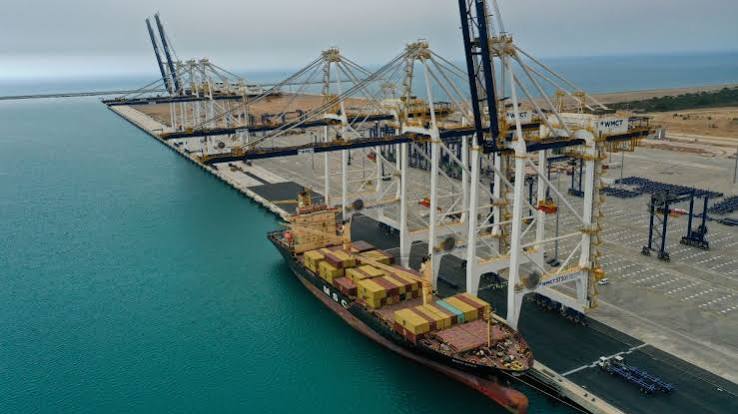
The development of the Nador West Med port complex is attracting growing attention from Spanish media outlets, which increasingly view it as far more than another maritime infrastructure project. Located just a few kilometres from Melilla, the Moroccan mega-port is emerging as a major logistics, industrial and energy hub with the potential to reshape economic balances across the Western Mediterranean. Between concerns over competition, strategic considerations and opportunities for cooperation, the Spanish press is examining the implications of a project that reflects Morocco’s expanding maritime ambitions.
Morocco is steadily strengthening its position in international maritime trade through a long-term strategy built around modern port infrastructure, industrial development, integrated logistics and energy diversification. Following the remarkable success of Tanger Med, which has become a leading maritime gateway between Europe, Africa and global markets, the Kingdom is positioning Nador West Med as a second pillar of its port and industrial development strategy.
This ambition has not gone unnoticed across the Strait of Gibraltar. Several Spanish media outlets have devoted increasing attention to the project’s economic and geopolitical implications, particularly its potential impact on Spanish ports, including Algeciras and Valencia.
In an article published on November 2, 2026, the Spanish newspaper El Español highlighted the scale of the investments committed to the complex and its geographical proximity to Melilla. The publication placed Nador West Med within Morocco’s broader strategy to strengthen its influence over Mediterranean trade routes and establish itself as a major maritime and industrial player.
With total announced public and private investment estimated at approximately MAD 54 billion, equivalent to around €5 billion, Nador West Med aims to become an integrated platform for international trade, industrial production, logistics and energy activities. Its economic significance therefore extends well beyond conventional port operations.
Algeciras Faces an Emerging Competitor
For several Spanish observers, the emergence of Nador West Med comes amid intensifying competition between Mediterranean ports, particularly following the rapid expansion of Tanger Med.
The Andalusian newspaper Europa Sur, which closely follows developments at the Port of Algeciras, has highlighted the challenges posed by Morocco’s growing maritime capacity. The combination of Tanger Med and Nador West Med could further strengthen the Kingdom’s attractiveness to major international shipping companies, supported by modern infrastructure, competitive industrial zones and its strategic position between Europe and Africa.
This evolving competition extends beyond container-handling volumes. It increasingly concerns the ability to attract international manufacturing investment, develop integrated logistics services, improve supply-chain efficiency and secure a larger share of global trade flows.
For Spanish port authorities, the challenge is therefore not merely to preserve existing maritime traffic but to reinforce the competitiveness of their broader industrial and logistics ecosystems.
An Industrial Strategy Drawing Madrid’s Attention
Beyond competition between ports, Spanish economic media have increasingly focused on the coherence of Morocco’s industrial development model.
Nador West Med is not designed as an isolated maritime facility. Instead, it forms the centrepiece of a wider economic ecosystem combining port operations, industrial production, energy infrastructure and regional development.
This integrated approach represents one of the main strengths of Morocco’s strategy. By connecting maritime infrastructure with industrial zones and logistics networks, the Kingdom seeks to capture greater added value, attract multinational manufacturers and strengthen its export capabilities.
The project’s energy dimension is equally significant. Planned facilities for hydrocarbons and liquefied natural gas could contribute to diversifying Morocco’s energy supply infrastructure while reinforcing its position in regional energy trade.
These developments raise an important strategic question for Spain: how can its ports maintain their competitiveness against a neighbouring country investing simultaneously in maritime infrastructure, industrial capacity, energy facilities and integrated logistics?
The answer will depend not only on infrastructure investment but also on operational efficiency, technological innovation, regulatory competitiveness and the ability to attract high-value industrial activities.
Morocco’s Oriental Region Enters a New Economic Era
The economic significance of Nador West Med extends far beyond Moroccan-Spanish relations. For Morocco’s Oriental region, the complex represents a major opportunity for structural economic transformation, particularly in an area that has historically faced challenges related to industrial development, employment and investment attractiveness.
The establishment of new manufacturing companies, the expansion of transport and logistics activities, the development of industrial subcontracting and the emergence of specialised services could contribute to diversifying the regional economy.
The project also offers opportunities for small and medium-sized enterprises seeking to integrate into international supply chains.
However, turning this potential into sustainable economic growth will require continued investment in road and rail connectivity, workforce training, industrial land development and support for local businesses.
The region’s long-term success will ultimately depend on its ability to transform port capacity into productive investment, skilled employment and lasting territorial development.
From Port Rivalry to Mediterranean Economic Integration
Although some Spanish media coverage emphasises competition between Moroccan and Spanish ports, this interpretation does not capture the full range of economic opportunities emerging from the project.
The development of Nador West Med could also create new business prospects for Spanish companies specialising in maritime engineering, industrial equipment, logistics, port services, renewable energy and infrastructure development.
Spain remains one of Morocco’s leading trading partners, and the growing integration of their economies could encourage the establishment of increasingly interconnected production and distribution networks across both shores of the Mediterranean.
Rather than generating exclusively competitive pressures, the expansion of Morocco’s port infrastructure could contribute to strengthening regional trade and industrial cooperation.
The real competition will ultimately depend on service quality, operational efficiency, transport costs, customs procedures, technological capabilities and the ability to establish sustainable industrial partnerships.
Through Nador West Med, Morocco is reaffirming a fundamental strategic objective: transforming its maritime coastlines into instruments of economic sovereignty, industrial competitiveness and international influence.
The growing attention devoted to the project by Spanish media reflects Morocco’s expanding role in the reorganisation of Mediterranean trade and investment flows.
Following the success of Tanger Med, Nador West Med could mark the beginning of a new chapter in Morocco’s emergence as a major maritime, industrial and energy power. For Spain, the challenge is no longer simply to observe the rapid expansion of its southern neighbour’s ports, but to adapt its own economic and maritime strategy to a Morocco increasingly capable of shaping the future of international trade across the Western Mediterranean.