



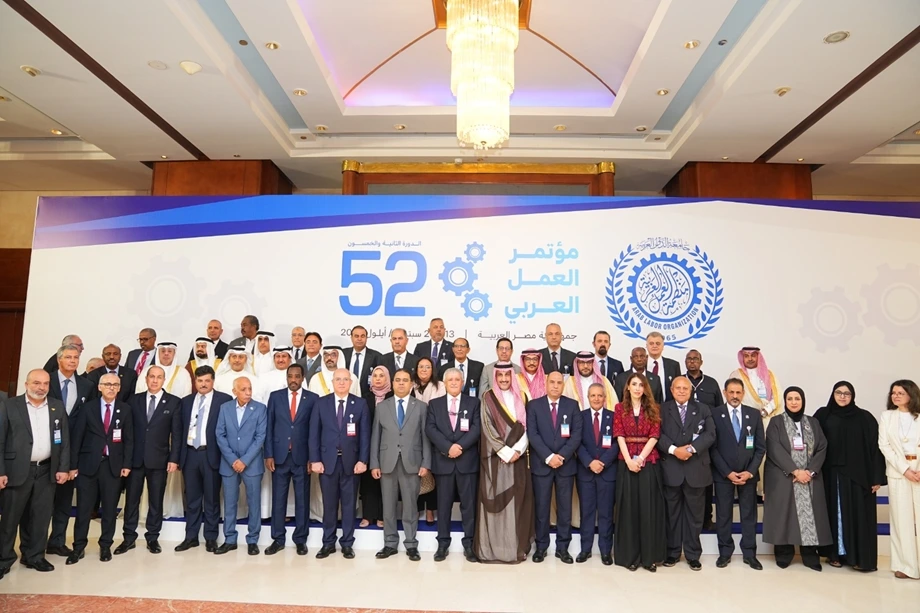
Moroccan delegation representing the three production partners
Morocco is represented at the conference by a delegation headed by Nour El Ammarti, Acting Secretary-General of the Ministry of Economic Inclusion, Small Business, Employment and Skills.
The delegation also includes representatives of the General Confederation of Moroccan Enterprises (CGEM), the Federation of Moroccan Chambers of Commerce, Industry and Services (FCMCIS), the Moroccan Workers’ Union (UMT), the General Union of Moroccan Workers (UGTM), and the Democratic Confederation of Labour (CDT).
The Moroccan participation reflects the involvement of the various production partners in discussions on the future of employment, social dialogue and labour policies in the Arab world.
Employment and labour market challenges at the forefront
Nour El Ammarti said the conference is addressing a number of structural challenges facing Arab labour markets, particularly the shortage of employment opportunities, especially for young people and women.
Participants are also discussing new challenges arising from the digital transformation, artificial intelligence and climate change, amid rapid changes reshaping the world of work.
El Ammarti stressed the existence of a collective Arab commitment to pursuing joint action and strengthening partnership and solidarity in addressing these challenges.
Artificial intelligence and digital transformation reshaping the world of work
During the opening session, Egyptian Minister of Labour and Chairman of the ALO Board of Directors Hassan Raddad reaffirmed his country’s support for joint Arab efforts aimed at promoting development, creating employment opportunities for young people, protecting workers, and strengthening social dialogue and social protection.
For his part, ALO Director-General Fayez Ali Al-Mutairi highlighted the qualitative developments achieved by the organization in recent years in the areas of development and modernization, as well as its growing regional and international presence and the diversification of its programs to better respond to the needs of the three production partners.
He noted that the organization has addressed new issues arising from rapid changes in the world of work, ranging from digital transformation and artificial intelligence to emerging economies and new skills, while continuing to serve as an Arab platform for tripartite social dialogue.
Sustainable economic growth at the heart of the conference
The 52nd session, chaired by Jordan, brings together around 530 participants representing governments, employers and workers, as well as Arab, regional and international organizations and federations and experts in labour and development.
The conference is focusing on the theme “Sustainable Economic Growth: Towards Comprehensive and Equitable Social Development in Arab Countries.”
Participants are also examining climate change and its impact on the workplace, as well as the opportunities available to startups in the context of digital transformation.
New report on employment and unemployment
The agenda also includes a review of the ALO’s activities and achievements for 2025, as well as its draft plan and budget for 2027-2028.
The conference will also see the launch of the ninth edition of the “Report on Employment and Unemployment in the Arab Countries,” which examines developments and challenges affecting labour markets across the region.
The conference provides an opportunity to strengthen tripartite social dialogue and exchange experiences among Arab countries, with a view to developing joint approaches to employment challenges and promoting more inclusive and equitable social and economic development.