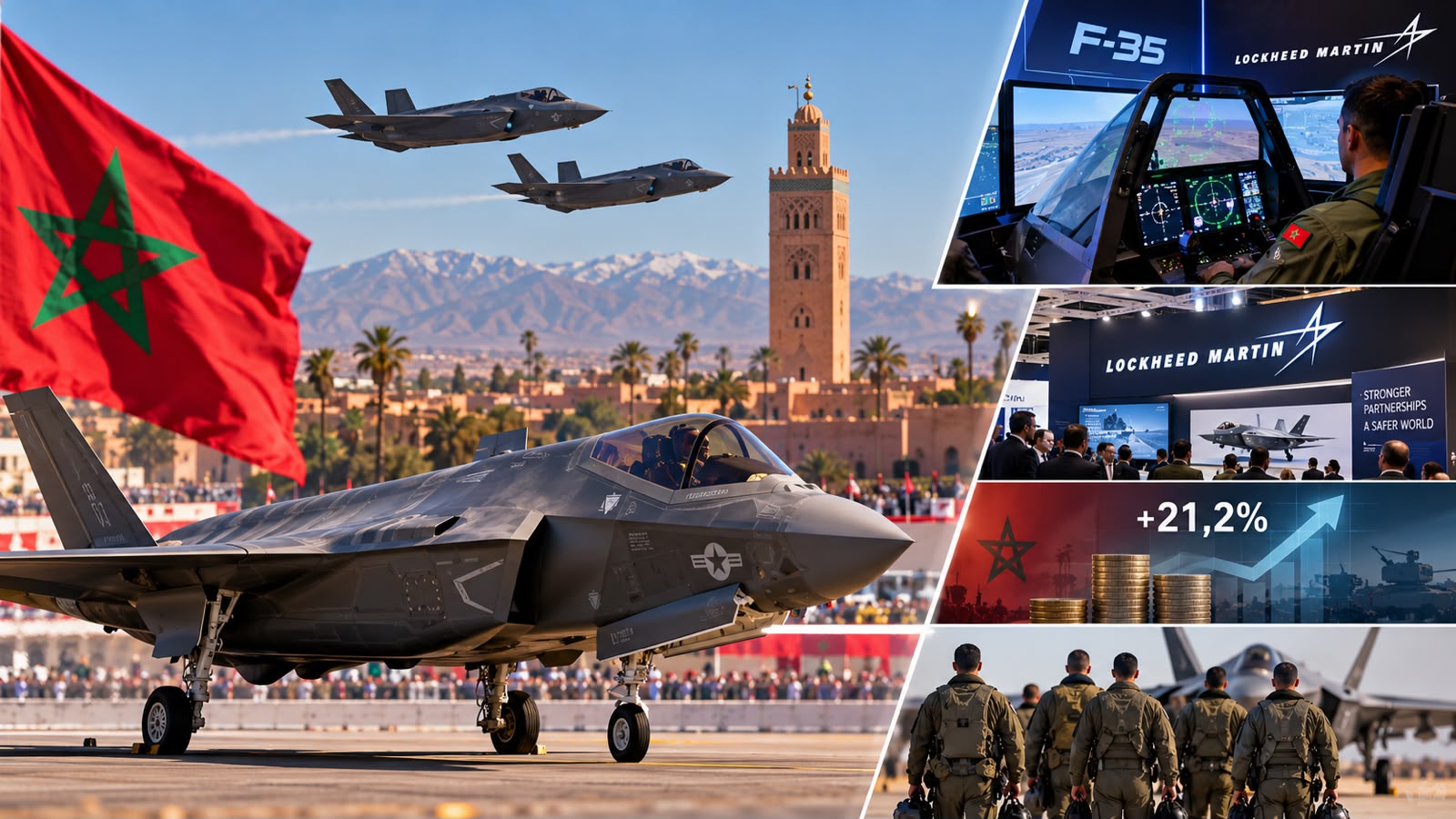
The appearance of two American F-35A stealth fighters at the Marrakech Airshow 2026, Lockheed Martin’s industrial initiatives in Morocco and the expansion of the Kingdom’s defence spending commitments have reignited speculation about a possible acquisition of the fifth-generation aircraft by the Royal Moroccan Air Force. Although no purchase agreement has been officially confirmed, these developments highlight strategic considerations extending far beyond a conventional military transaction. At stake are the modernisation of Morocco’s air capabilities, the emergence of a domestic defence industry, the development of advanced technological expertise and the Kingdom’s integration into global aerospace value chains. For Rabat and Washington alike, the greater opportunity may lie in transforming a longstanding military relationship into a sustainable industrial and technological partnership.
The prospect of Morocco joining the group of countries operating the American F-35 fighter jet is attracting growing attention within defence and aerospace circles. Several developments in October 2026 have fuelled this possibility, including the participation of two US Air Force aircraft in the Marrakech Airshow, Lockheed Martin’s presentation of an F-35 cockpit demonstrator and media reports suggesting that Moroccan pilots could receive training in the United States. Nevertheless, these developments, however significant, do not establish that an order has been placed or that a formal acquisition agreement has been reached.
The economic significance of this issue extends well beyond the renewal of Morocco’s combat aircraft fleet. Against a global backdrop of restructuring supply chains, growing technological sovereignty concerns and the increasing strategic importance of defence manufacturing, Morocco could leverage its partnership with Washington to strengthen its productive capacity, attract new investment and develop highly specialised industrial expertise.
This prospect is consistent with Morocco’s broader industrial diversification strategy. Having established competitive manufacturing ecosystems in the automotive, civil aerospace and electrical equipment industries, the Kingdom is seeking to progressively expand its capabilities in defence manufacturing. Cooperation with major American defence contractors could accelerate this transition, provided it results in concrete industrial projects and measurable commitments.
Defence spending commitments strengthen prospects for military modernisation.
Morocco’s draft Finance Bill for 2027 provides an important financial indicator of this strategic direction. The government plans to raise the ceiling for advance commitments covering the acquisition and repair of Royal Armed Forces equipment and support for the domestic defence industry to MAD 190.5 billion, compared with MAD 157.17 billion in 2026, representing an increase of 21.2%.
This development reflects the Kingdom’s intention to preserve sufficient financial flexibility to support major military programmes whose contractual obligations and payments may extend over several fiscal years. However, the distinction between advance commitment authorisations and actual annual expenditure is essential. The MAD 190.5 billion figure does not represent the annual defence budget or an amount entirely available for procurement in 2027. Separately, the relevant special account has been allocated MAD 11.49 billion for that year.
Should Morocco eventually decide to acquire F-35 aircraft, the financial implications would be substantial. Beyond the purchase price, the programme would require specialised infrastructure, logistical support systems, pilot and technical personnel training, secure information technology, spare parts, maintenance and continuous upgrades. Such an acquisition would therefore represent a long-term financial and operational commitment spanning several decades.
The increase in budgetary commitment capacity cannot consequently be interpreted as evidence of an imminent F-35 purchase. It does, however, demonstrate the importance Morocco attaches to modernising its military equipment and developing a national industrial base capable of supporting this transformation.
Lockheed Martin opens new opportunities for Moroccan industry.
The clearest economic signal comes from Lockheed Martin’s industrial initiatives in Morocco. Participating in the Marrakech Airshow 2026 as a Platinum sponsor, the American aerospace and defence group organised a dedicated industry day on October 6, attended by representatives of Morocco’s Ministry of Industry and Trade. The initiative aimed to identify Moroccan companies capable of entering its supplier network and meeting the demanding technical and quality requirements of its industrial programmes.
This initiative creates opportunities that are not necessarily dependent on Morocco purchasing F-35 aircraft. The Kingdom already maintains a relationship with Lockheed Martin through its F-16 fighter jets and Hercules military transport aircraft. Expanding this cooperation could create additional opportunities in aerospace subcontracting, maintenance, engineering, precision machining, component manufacturing and specialised industrial services.
Morocco possesses significant advantages to support such a transition. Over the years, its aerospace industry has developed expertise in component manufacturing, electrical wiring, assembly, surface treatment and maintenance. These capabilities provide a foundation that could progressively be applied to selected segments of military aerospace manufacturing, subject to the necessary certifications, export authorisations and international standards.
For American companies, a deeper industrial partnership with Morocco could support supplier diversification, provide proximity to European markets and capitalise on the Kingdom’s established industrial and logistics infrastructure. For Moroccan manufacturers, the opportunity lies in entering technologically demanding markets, expanding production capabilities and securing long-term industrial contracts.
However, the success of such cooperation will depend on the ability of domestic companies to comply with international requirements relating to quality, traceability, security and regulatory compliance. Industry meetings are only an initial step. The real economic impact will be measured through supplier qualifications, contracts awarded, investments completed and skilled jobs created.
Marrakech Airshow highlights growing interest in advanced military technologies.
The participation of two US Air Force F-35A stealth fighters in the Marrakech Airshow on October 7, 2026, was among the event’s most prominent developments. The aircraft came from the 48th Fighter Wing, stationed at RAF Lakenheath in the United Kingdom, underscoring the strategic depth of military cooperation between Rabat and Washington.
At the same time, Lockheed Martin presented a cockpit demonstrator designed to introduce selected visitors to the technological environment of its fifth-generation fighter aircraft. Beyond its stealth capabilities, the F-35 incorporates advanced sensor fusion, digital systems and information-sharing technologies that significantly transform modern air operations.
The relevance of these technologies extends beyond aircraft performance. Their operation requires advanced expertise in information technology, cybersecurity, engineering, simulation, maintenance and complex systems management. Introducing such aircraft into service would therefore require substantial adaptation of infrastructure, operational procedures and training systems.
Another development attracted attention when the Moroccan newspaper Assahifa reported on October 8 that Morocco had allegedly requested training for Royal Moroccan Air Force pilots on the F-35A, potentially at Luke Air Force Base in Arizona. This information, however, has not been publicly confirmed by the relevant authorities.
If officially substantiated, such a request could indicate a more advanced assessment of Morocco’s future air capabilities. It would not, however, establish that a purchase decision had been made. Technological demonstrations, operational evaluations, training requests, export approvals and final procurement contracts represent distinct stages that must not be confused.
From military procurement to domestic industrial value creation.
For Morocco, the central challenge is not simply the possibility of acquiring one of the world’s most advanced fighter aircraft. It is the ability to convert military investment into measurable economic, industrial and technological benefits.
International experience demonstrates that purchasing sophisticated military equipment does not automatically create a strong domestic defence industry. A country may operate a modern combat aircraft fleet while remaining heavily dependent on foreign suppliers for maintenance, spare parts, software and sensitive technologies.
Morocco would therefore benefit from integrating major defence procurement programmes into a broader national industrial development strategy, supported by clearly defined objectives. These could include qualifying domestic suppliers, developing maintenance capabilities, training engineers and technicians, investing in applied research and participating in international aerospace subcontracting programmes.
Such activities could also generate important synergies with civilian industries. Skills acquired in precision manufacturing, advanced materials, electronic systems, cybersecurity and quality management could strengthen the competitiveness of several industrial sectors and expand Morocco’s export capabilities.
Nevertheless, technology transfer must be approached realistically. The F-35 programme operates under strict American regulations governing security, export controls and the protection of sensitive technologies. Any potential acquisition would not automatically provide Morocco with access to aircraft manufacturing rights, proprietary software or the most sensitive onboard systems.
Negotiating clearly defined, authorised and economically viable industrial activities could therefore be just as strategically important as the aircraft acquisition itself.
A strategic partnership offering economic benefits to both countries.
For the United States, deeper cooperation with Morocco could generate opportunities extending well beyond military equipment sales. Maintenance, training, logistical support and modernisation programmes can sustain industrial and commercial relationships over several decades while reinforcing ties with a strategic partner in North Africa.
Morocco’s geographical position, logistics infrastructure and experience in attracting international investment could also facilitate new relationships between American companies and Moroccan suppliers, within the applicable regulatory and export-control frameworks.
These possibilities are particularly relevant as major industrial powers seek to diversify their supply chains and reduce excessive dependence on individual production centres.
For Morocco, the objective would be to strengthen domestic industrial and technical capabilities while recognising the dependencies inherent in advanced military technologies. Developing a national base of skilled personnel, services and manufacturing activities could improve equipment support capabilities while opening new markets for Moroccan companies.
Training represents a particularly important driver of this transformation. Growing demand for aerospace engineers, embedded systems specialists, maintenance technicians and cybersecurity professionals could encourage partnerships between manufacturers, universities, technical training institutions and public agencies.
The scale of these benefits would nevertheless depend on the nature of the agreements concluded, the industrial activities actually authorised and the ability of Moroccan companies to meet the requirements of major international contractors on a sustained basis.
The F-35: A financial and industrial decision as much as a military choice.
A potential Moroccan acquisition of the F-35 would represent a major strategic decision, requiring evaluation not only of the aircraft’s technical performance but also of its total lifecycle cost, operational availability and compatibility with the Royal Moroccan Air Force’s existing capabilities.
The decision would need to be assessed alongside other priorities, including combat aircraft modernisation, air defence systems, unmanned aerial vehicles, surveillance and reconnaissance capabilities, electronic warfare and training. Selecting a new aircraft platform cannot be separated from the broader architecture of the military capabilities Morocco intends to develop over the medium and long term.
The political dimension constitutes another critical factor. F-35 exports are subject to specific American procedures involving government authorisations, security requirements and controls on sensitive technologies. Any potential Moroccan request would therefore have to pass through several institutional, technical and financial stages before resulting in a binding procurement agreement.
As of October 26, 2026, the available information confirms the participation of American F-35A aircraft in the Marrakech Airshow, Lockheed Martin’s presentation of a cockpit demonstrator and initiatives aimed at engaging Moroccan industrial suppliers. However, these developments do not establish any officially confirmed contract for Morocco to purchase the aircraft.
Beyond the F-35: Building industrial and technological sovereignty.
The strategic importance of this issue ultimately lies in the potential transformation of Moroccan-American relations from traditional military cooperation into a broader partnership encompassing manufacturing, technology, training and specialised services. Expanding aerospace defence cooperation could allow Morocco to enter a new phase in developing its national defence industrial ecosystem, provided announced initiatives translate into concrete industrial projects.
Over recent years, the Kingdom has accumulated considerable experience in attracting international manufacturers and developing export-oriented production platforms. Progressively applying these capabilities to defence manufacturing could contribute to economic diversification, the creation of highly skilled employment and a stronger position in technologically advanced industries.
Achieving these ambitions, however, requires a long-term vision combining investment, professional training, scientific research, industrial certification and support for domestic companies. It also calls for measurable performance indicators, including the number of qualified suppliers, the value of industrial contracts, domestic value added, jobs created and skills developed on a sustainable basis.
The F-35 could become one of the defining symbols of a new phase in strategic cooperation between Rabat and Washington. It should not, however, be regarded as the sole determinant of Morocco’s defence industrial future.
Morocco’s ultimate success would not be measured simply by joining the select group of countries operating fifth-generation fighter aircraft, but by its ability to become an industrial partner capable of manufacturing, maintaining, innovating and participating sustainably in global aerospace and defence value chains.
It is precisely through this combination of military modernisation, industrial competitiveness, national skills development and technological capability that one of the most significant long-term opportunities in the economic partnership between Morocco and the United States could emerge.