




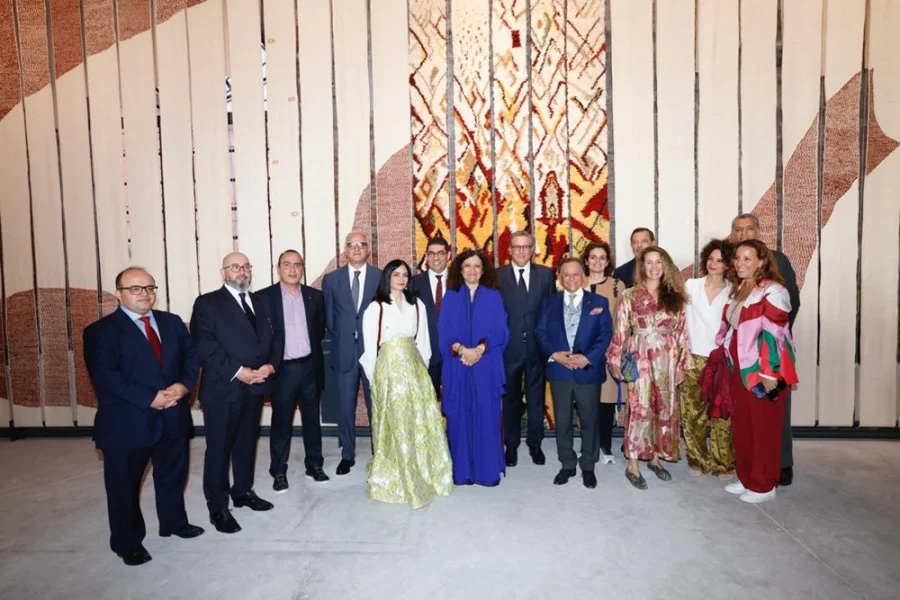

Morocco continues to strengthen its position on the global cultural stage by making culture a strategic driver of human and social development, said Mohamed Benyacoub, commissioner of the Moroccan Pavilion at the 61st International Art Exhibition of the Venice Biennale.
Speaking during the official inauguration of the Kingdom’s Pavilion by Head of Government Aziz Akhannouch, held under the High Instructions of HM King Mohammed VI, Benyacoub stressed that Morocco has successfully combined international outreach with the consolidation of its national identity through an ambitious cultural vision.
“The Kingdom’s emergence resonates with its plural roots, its culture, and the dynamism of its youth,”
he said, highlighting the growth of museums, fine arts schools, and cultural institutions, as well as strengthened protection of artists’ rights.
This year, the Moroccan Pavilion presents “Aseṭṭa,” an immersive installation conceived by artist Amina Agueznay and curator Meryem Berrada. Inspired by the Amazigh weaving loom, the project celebrates Moroccan craftsmanship and ancestral weaving traditions.
According to Benyacoub, the artwork embodies Morocco’s vision rooted in local specificities, cultural diversity, and the various components of society in order to imagine a prosperous, sustainable, inclusive, and resilient future.
For his part, Mehdi Qotbi, president of the National Foundation of Museums (FNM), praised the symbolic significance of Morocco’s presence at the historic Arsenale site in Venice, underlining the growing international influence of Moroccan culture under the leadership of HM King Mohammed VI.
In a statement to MAP, Amina Agueznay explained that “Aseṭṭa,” which means “loom” in Amazigh, was created in collaboration with more than 160 women artisans specializing in carpet weaving, embroidery, beadwork, basketry, and crochet.
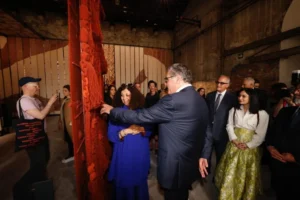
The installation unfolds as an immersive membrane surrounding both the space and the visitor through multiple experiential thresholds inspired by the Arabic concept of “Al-ataba.” The artist emphasized the project’s collective and predominantly female dimension, aimed at preserving and transmitting traditional craftsmanship.
Meryem Berrada added that “Aseṭṭa” pays tribute to the spirituality and human experience embedded in Morocco’s ancestral weaving traditions, going far beyond the material dimension of the crafted object itself.
Founded in 1895, the Venice Art Biennale remains one of the most prestigious events in the international art world and a major platform for nations seeking to promote their cultural identity globally.