




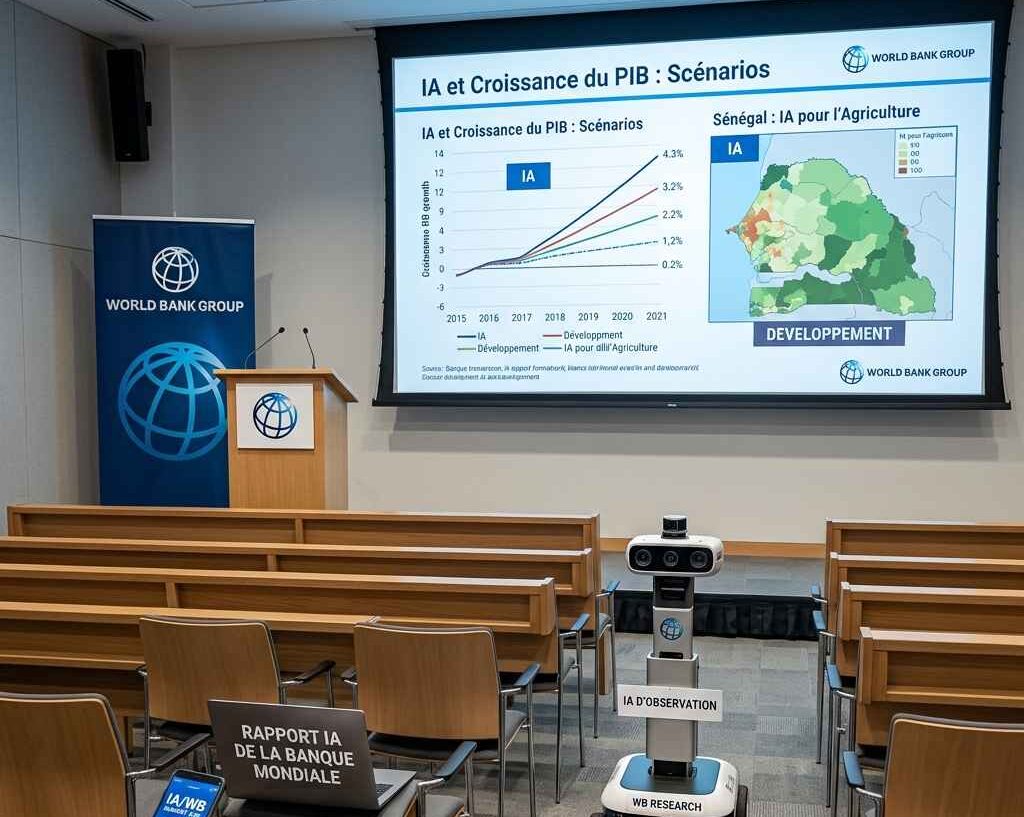

The World Bank has called on developing countries to move quickly in adopting artificial intelligence (AI) in order to strengthen economic growth, improve public services and avoid falling further behind technologically advanced economies.
In a report published Tuesday, the institution said AI could enable developing countries to achieve in one decade what might otherwise have taken a century. However, it stressed that governments must act rapidly by investing in energy infrastructure, digital connectivity, workforce skills and stronger institutions.
AI seen as a major opportunity for developing economies
According to the World Bank, artificial intelligence offers a unique opportunity for low- and middle-income countries to overcome long-standing development challenges.
“AI has thrown a lifeline to developing economies, and they need to seize it,” said World Bank Chief Economist Indermit Gill, warning that countries must move quickly as AI is spreading faster than previous technological revolutions.
The institution stressed that delaying adoption could widen the gap between developed and developing countries.
Infrastructure and skills remain key challenges
The report highlights several obstacles facing developing economies, including limited access to electricity, unreliable internet connectivity and insufficient financing capacity.
To benefit from AI, governments must strengthen their digital infrastructure, expand access to energy, improve education systems and develop a skilled workforce capable of using new technologies.
The World Bank said AI adoption should be based on a gradual strategy: first deploying available tools, then adapting them to local needs, and eventually developing more advanced solutions.
Affordable AI models could deliver rapid benefits
The report notes that developing countries do not necessarily need to immediately rely on the most advanced AI systems, such as ChatGPT from OpenAI or Claude from Anthropic.
Instead, simpler and more affordable AI models could provide faster and more practical solutions in areas such as healthcare, education, legal services and agriculture.
“These technologies can help deliver better services and improve productivity for millions of people,” the World Bank said.
AI could transform employment and productivity
While acknowledging that artificial intelligence will affect jobs, the World Bank estimates that the impact will be less severe in developing countries than in advanced economies.
Around 4.5% of jobs in low- and middle-income countries could be exposed to AI-related disruption, compared with 14.2% in richer economies.
At the same time, more than 16% of jobs in developing countries could benefit from increased productivity thanks to AI, a figure close to the 18.7% expected in high-income countries.
A narrow window of opportunity
The World Bank warned that without proactive policies, AI could deepen global inequalities and concentrate economic power among a limited number of technology companies.
The institution considers AI adoption particularly important at a time when global growth is slowing. It said the 2020s could become the weakest decade for global economic growth in the past 30 years, affected by repeated shocks including the COVID-19 pandemic, the war in Ukraine and geopolitical tensions.
The World Bank also revealed that its report itself was prepared with assistance from several advanced AI tools, including systems developed by OpenAI, Anthropic and China’s DeepSeek, under close supervision by the report team.