





OCP Group has reached a new milestone in its energy transition strategy. Its subsidiary OCP Green Energy has announced the energization of its first large-scale Battery Energy Storage System (BESS) at the Benguerir mining site.
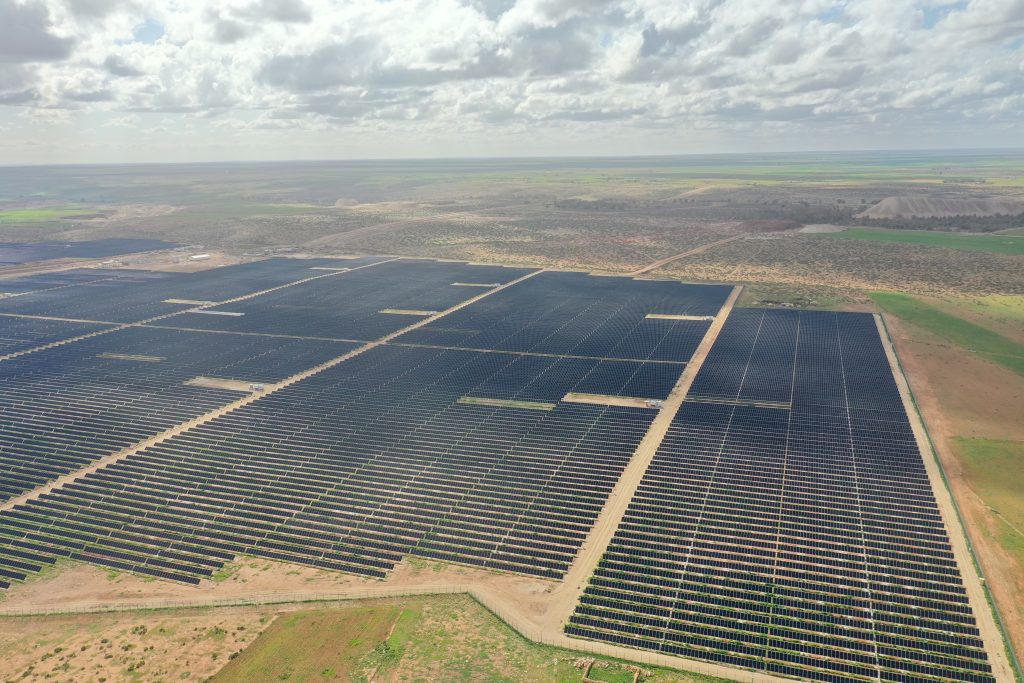
The energization marks the beginning of the progressive commissioning of the first phase of the storage system, just months after the launch of OCP Green Energy’s first photovoltaic capacity, totaling 202 MWp.
Five hours of energy storage
Connected to the existing photovoltaic plant at the Benguerir mining site, the BESS has a capacity of 25 MW / 125 MWh, equivalent to up to five hours of energy storage.
The system will store solar electricity generated during the day and release it when demand from industrial facilities is at its highest. The objective is to mitigate the intermittency of solar power while improving the flexibility and continuity of electricity supply.
The system will also be able to provide ancillary services, including frequency regulation and reactive power compensation.
It is designed to operate on a daily charge-and-discharge cycle, with an estimated lifespan of 25 years.
LFP technology at the heart of the project
OCP Green Energy selected Lithium Iron Phosphate (LFP) technology for the project. Following an evaluation and qualification process involving specialized integrators, the company signed a contract with technology provider ENVISION at the end of 2025 for the supply and commissioning of the storage system.
LFP technology was selected notably for its safety, thermal stability and long lifespan.
The equipment order, placed during the fourth quarter of 2025, also allowed OCP Green Energy to benefit from favorable market conditions and particularly competitive investment costs.
Nearly MAD 170 million invested
The project represents an investment of nearly MAD 170 million. The amount covers the acquisition of BESS equipment and batteries, as well as all integration works, including civil and electrical engineering, studies and project management.
According to OCP, these activities were carried out entirely using Moroccan expertise and skills.
The project also benefits from USD 20 million in financing from the Clean Technology Fund (CTF), a program supported by the African Development Bank and dedicated, among other areas, to the development of innovative solutions for renewable energy storage.
Lower electricity costs during peak hours
Once fully operational, the BESS will help align solar power availability with the energy requirements of the industrial site.
By storing electricity when solar generation is abundant and releasing it during peak periods, the system is expected to strengthen the reliability of renewable energy supplies.
OCP estimates that the system will also reduce the site’s electricity bill by 25% during peak hours.
“Energy storage is the natural extension of our energy strategy,” said Omar Kadir, Chief Executive Officer of OCP Green Energy, as quoted in the group’s statement.
According to the executive, the technology will make it possible to reconcile the variable nature of renewable energy production with the continuous requirements of OCP’s industrial platforms, while strengthening the reliability of its energy supply.
202 MWp of solar capacity already deployed
The BESS project follows the commissioning of OCP Green Energy’s first photovoltaic phase, representing 202 MWp of capacity across three solar plants: Benguerir with 67 MWp, Foum Tizi with 30 MWp, and Oulad Farès in Khouribga with 105 MWp.
These facilities are already supplying OCP Group’s industrial and mining sites with renewable electricity.
With the integration of energy storage, OCP Green Energy is taking another step forward: the strategy is no longer limited to generating solar electricity, but also involves storing it and making it available according to demand.
Towards a Moroccan LFP battery ecosystem
Beyond meeting the Group’s own energy needs, OCP believes that large-scale storage could contribute to the more effective integration of renewable energy into Morocco’s national electricity system.
The BESS project forms part of OCP Green Energy’s roadmap to progressively cover the Group’s entire electricity demand through clean energy sources.
At the same time, OCP Group and Mohammed VI Polytechnic University (UM6P) are working on the development of LFP materials produced from phosphoric acid, building on OCP’s expertise in phosphate-related activities.
Research and development work has resulted in high-performance LFP materials and proprietary intellectual property covering, among other areas, production processes and material characteristics.
These innovations are now entering the scaling-up phase ahead of potential industrialization, supporting OCP’s broader ambition to contribute to the development of an integrated lithium-ion battery ecosystem based on LFP technology in Morocco.
Performance testing to begin
Following the completion of the installation and integration of the batteries, power conversion equipment and control systems, OCP Green Energy energized the battery system.
The coming weeks will focus on performance testing, ahead of its full commissioning.
With this project, OCP aims to make renewable energy storage an additional driver of competitiveness, resilience and decarbonization across its industrial operations.