




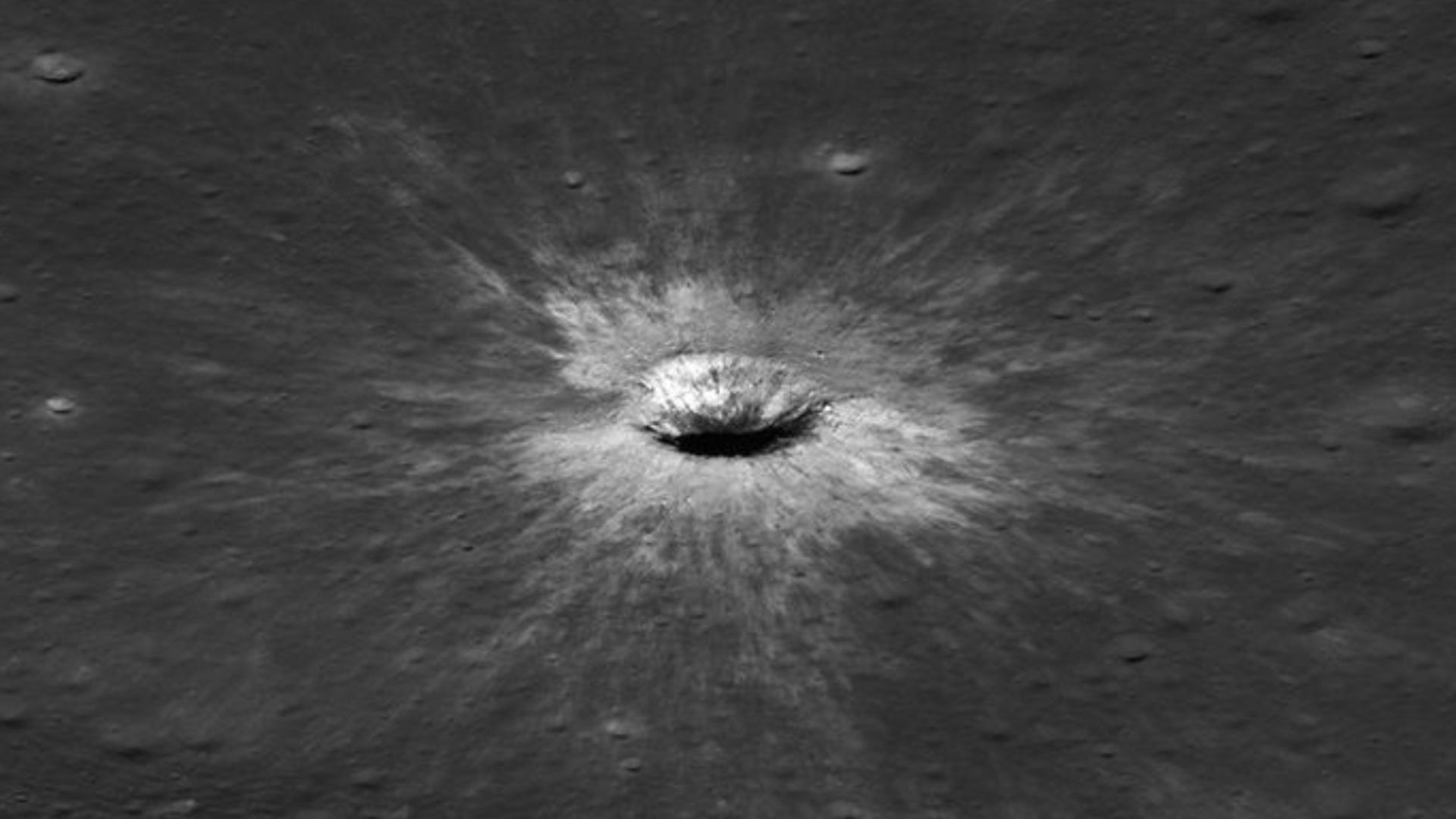

Named “McGetchin” in honor of a renowned lunar geophysicist, the crater measures approximately 222 meters in diameter. According to NASA, it was likely created when a comet or asteroid struck the lunar surface in the spring of 2024.
The crater initially went unnoticed. It was identified almost by chance by an American researcher working with data from the Lunar Reconnaissance Orbiter Camera (LROC), an instrument aboard NASA’s Lunar Reconnaissance Orbiter, which has been studying the Moon since 2009.
In the images, the crater appears as a bright spot surrounded by a dark halo. Researchers identified it as the largest recently formed crater ever detected in the Solar System.
Although the Moon is covered with countless craters, some of them much larger, observing the formation of a crater relatively close to real time and monitoring its evolution provides scientists with a rare opportunity to study impact processes and the Moon’s complex geology.
The observations could also help prepare future crewed missions to the Moon, as the United States and China pursue programs that include plans to establish infrastructure and bases on the lunar surface.
Unlike Earth, the Moon has virtually no atmosphere. Meteoroids, asteroids and other space debris can therefore reach its surface without being significantly slowed down or burned up in the atmosphere.
Researchers estimate that the object responsible for creating the McGetchin crater was roughly the size of a three- to six-story building.