
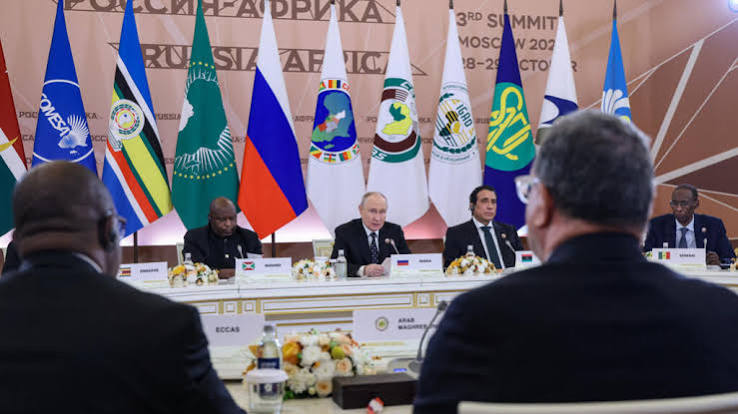
Beyond the rhetoric of multipolarity, the third Russia–Africa Summit highlights an intensifying international competition for strategic resources, industrial markets, energy infrastructure and diplomatic partnerships. China, the United States and the European Union are pursuing interests that sometimes converge but frequently compete. Economic data reveal a striking paradox: Russia exercises considerable geopolitical influence in parts of Africa despite possessing a far smaller commercial and financial footprint than its principal competitors. This evolving balance of power presents African governments with a fundamental challenge: transforming competition among global powers into stronger economic bargaining power, industrial development and greater strategic autonomy.
Moscow Seeks to Transform Political Influence into Economic Power
Held in Moscow on October 28–29, 2026, the third Russia–Africa Summit comes at a decisive moment in the restructuring of international relations. Following the gatherings in Sochi in 2019 and St. Petersburg in 2023, Russia is seeking to expand its African strategy beyond diplomacy and security cooperation by strengthening its presence in energy, agriculture, mining, manufacturing, transportation and technology.
The summit brings together delegations from nearly 50 African countries and approximately 20 heads of state. It forms part of Moscow’s broader effort to consolidate political partnerships, diversify export markets and deepen cooperation in strategically important sectors.
President Vladimir Putin has emphasized bilateral trade exceeding $27 billion in 2025, alongside Russian grain deliveries, military cooperation and educational partnerships. However, the figures also reveal the limitations of Moscow’s economic ambitions.
In 2019, Russia announced its intention to increase trade with Africa to $40 billion. Seven years later, bilateral trade stands at approximately $27.1 billion, representing just 67.8% of that target. The $12.9 billion shortfall demonstrates that Russia’s diplomatic influence has not yet translated into an equivalent expansion of commercial relations. This discrepancy is central to understanding how Beijing, Washington and Brussels assess Moscow’s ambitions across Africa.
The Commercial Balance Remains Heavily Unfavorable to Russia
Available trade figures illustrate the significant differences in economic scale between Russia and its principal competitors in Africa.
| Africa’s trading partner | Merchandise trade in 2025 | Relative to Russian trade |
|---|---|---|
| European Union | Approximately $395 billion | 14.6 times |
| China | Approximately $348 billion | 12.8 times |
| Russia | $27.1 billion | 1 time |
Rounded figures in US dollars. Trade statistics do not measure investment stocks, political influence or security cooperation. US trade is excluded because a directly comparable verified 2025 figure is not established here.
These disparities reveal the structure of international economic competition on the African continent. Russia’s trade represents less than 8% of China’s exchanges with Africa and less than 7% of those conducted by the European Union.
The investment comparison is equally revealing. In 2024, the European Union held more than €250 billion in foreign direct investment stocks in Africa. Its Global Gateway initiative also aims to mobilize up to €150 billion in public and private investment for the continent.
Of the 264 flagship projects identified under this initiative, 138 concern Africa. However, these figures represent investment ambitions and commitments rather than evidence that all the announced funding has already been disbursed.
Russia therefore operates with a considerably smaller economic footprint. Yet this relative weakness should not obscure Moscow’s ability to concentrate resources in particularly sensitive sectors, where targeted investments can generate political influence disproportionate to their financial value.
China: Geopolitical Convergence Does Not Eliminate Economic Competition
For Beijing, the Moscow summit carries two distinct implications. Diplomatically, stronger Russia–Africa relations may reinforce efforts to promote a multipolar international order. China and Russia both advocate reforms to global governance and greater representation for emerging economies in international institutions.
Their cooperation within BRICS strengthens this convergence. South Africa, Egypt and Ethiopia now participate in the grouping, expanding opportunities for dialogue between emerging powers and African governments.
However, geopolitical alignment does not necessarily imply identical economic interests. With approximately $348 billion in trade with Africa in 2025, China possesses a deeply established economic presence built through decades of industrial expansion, infrastructure investment and integration into global supply chains. Chinese companies operate across transportation infrastructure, railways, ports, electricity generation, telecommunications, mining, industrial equipment and digital technologies.
Russia is seeking to strengthen its position in several of these same sectors. Competition could intensify around uranium, copper, cobalt, lithium, hydrocarbons and strategic energy infrastructure. These resources are essential to global industrial supply chains, from battery manufacturing and electrical equipment to advanced electronics and military technologies.
China nevertheless enjoys a structural advantage: its ability to combine financing, construction, equipment supply, industrial operations and access to domestic markets. Russia, by contrast, can offer specialized technological cooperation, particularly in civilian nuclear energy, fertilizers, hydrocarbons and selected defense industries. Beijing may therefore regard Russia’s growing African presence as diplomatically compatible with its international objectives while recognizing the potential for economic competition in particular countries and industries.
China’s principal concern is not necessarily the overall volume of Russia–Africa trade, but Moscow’s potential acquisition of privileged positions in strategically important resources and infrastructure.
The United States: Critical Minerals at the Center of Strategic Calculations
Washington’s assessment of the summit reflects economic and security concerns that increasingly converge around one central issue: control over strategic supply chains.
American industry depends on raw materials essential to aerospace manufacturing, electronics, defense systems, batteries and energy-transition technologies.
Africa plays a significant role in several of these supply chains. The Democratic Republic of the Congo is a major producer of cobalt and copper. Zambia possesses substantial copper resources. Southern Africa holds important deposits of platinum-group metals, chromium and manganese.
Several African countries also possess graphite, lithium, uranium and rare-earth resources. Competition extends beyond ownership of mineral deposits. It increasingly concerns the ability to finance extraction, transport raw materials, develop refining capacity and control industrial supply chains through to final markets.
The Lobito Corridor illustrates this strategic dimension. Supported by the United States and the European Union, the project seeks to improve logistics connections between Central Africa’s mining regions and the Angolan Atlantic port of Lobito.
Beyond railway infrastructure, the objective is to diversify export routes and facilitate access to critical raw materials. A stronger Russian presence in mineral-producing countries could complicate commercial negotiations, alter access conditions or create new strategic dependencies.
However, US policy cannot be understood solely through its opposition to Moscow. Washington is also seeking to reduce certain industrial dependencies on China. The United States must therefore navigate competition on several levels: addressing security concerns, diversifying strategic supplies and developing economic partnerships capable of attracting African governments.
This environment may encourage Washington to place greater emphasis on concrete industrial investment rather than diplomatic declarations alone.
The European Union: Defending Economic Influence in an Increasingly Competitive Environment.
For Brussels, Russia’s African offensive comes amid profound changes in Euro-African relations. The European Union retains considerable commercial influence. Its merchandise trade with Africa reached approximately €355 billion in 2024, supplemented by more than €110 billion in services trade.
European investors held more than €250 billion in direct investment stocks across the continent that year. The depth of this relationship is also reflected in market access: more than 90% of African exports enter the European Union duty-free under various preferential arrangements.
These figures demonstrate the scale of an established economic relationship that Russia cannot readily replace. Nevertheless, economic weight no longer automatically guarantees equivalent diplomatic influence. Developments in the Sahel, particularly in Mali, Burkina Faso and Niger, illustrate the reassessment of traditional security partnerships. Russia has strengthened its presence in these countries, while several Western military arrangements have been reorganized or withdrawn.
For Brussels, these developments expose a structural challenge: substantial economic relations can coexist with declining political influence.
The European Union must also respond to African governments’ growing expectations concerning domestic processing of raw materials, access to financing, energy infrastructure and industrial job creation. The challenge therefore extends beyond competition with Moscow. It concerns Europe’s ability to develop partnerships that move beyond raw-material exports toward the creation of African industrial value chains.
In this context, Global Gateway represents an important strategic instrument. Its credibility, however, will depend on actual investment delivery, implementation timelines and measurable industrial outcomes. Europe consequently faces a dual imperative: protecting its established economic relationships while adapting its partnerships to Africa’s evolving development ambitions.
Civilian Nuclear Energy: A Major Instrument of Russian Strategic Projection.
Civilian nuclear energy is among the sectors where Russia possesses particularly significant industrial capabilities. The state-owned Rosatom group is developing cooperation projects with several African countries, including Egypt, Ethiopia, Namibia, Tanzania and Togo. Egypt’s El Dabaa nuclear power project represents a major infrastructure development, comprising four reactors with a planned capacity of 1,200 megawatts each.
The facility’s total projected generating capacity is therefore 4,800 megawatts. Alongside conventional nuclear projects, Russia is pursuing another technological approach: floating nuclear power plants. Rosatom has engaged in advanced discussions with Egypt, Togo, Namibia and Tanzania concerning units of approximately 100 megawatts that could supply electricity to national grids, industrial zones or energy-intensive facilities.
The Russian proposal includes electricity supply arrangements under which maintenance and nuclear fuel replacement would remain the responsibility of the Russian operator. Such arrangements may reduce certain initial capital requirements compared with conventional land-based nuclear facilities.
However, they also raise questions concerning technological dependence, nuclear safety, electricity costs and contractual governance. With operating lifetimes potentially extending to 60 years, these projects represent considerably more than ordinary commercial transactions. They could establish long-term technological and industrial relationships between Russia and participating African countries.
For China, the United States and the European Union, energy competition therefore extends beyond power plant construction. It also involves equipment supply, technical standards, nuclear fuel, maintenance and engineering training.
Agriculture and Fertilizers: A Less Visible but Decisive Source of Influence.
Agriculture represents another important pillar of Russia’s African strategy. According to figures presented in Moscow, Russia supplied more than 18 million tonnes of grain to African countries in 2025 and approximately 13 million tonnes during the first nine months of 2026.
Russian mineral fertilizer exports to Africa reportedly reached approximately 1.5 million tonnes in 2025, before exceeding 2.2 million tonnes during the reported period in 2026. These volumes demonstrate the importance of agricultural products and inputs in Africa’s food security. For several African economies dependent on wheat imports, access to Russian grain represents an important source of supply.
However, this relationship also reveals substantial commercial asymmetry. During the first eight months of 2026, Russian exports to Africa reportedly reached approximately $14 billion, compared with just $3.2 billion in Russian imports from the continent.
This represents approximately $4.40 in Russian exports for every dollar imported from Africa during the period. Such an imbalance highlights the difficulties African economies face in diversifying their exports to the Russian market.
For African countries, the strategic objective should extend beyond securing wheat and fertilizer supplies. It should include developing food-processing industries, manufacturing facilities, storage infrastructure and regional logistics networks. Without such progress, cooperation risks reinforcing import dependence rather than strengthening productive sovereignty.
Security: Russian Influence Faces the Test of Results.
Military cooperation remains one of the summit’s most sensitive dimensions. Moscow states that it maintains military and military-technical cooperation agreements with 45 African countries. This network illustrates the geographical reach of Russia’s institutional relationships, although the agreements differ considerably in scope and implementation.
Arms-transfer data provide another perspective. During 2021–2025, the United States accounted for approximately 19% of African imports of major weapons, followed by China at 17%, Russia at 15% and France at 8.3%.
Globally, Russian exports of major weapons declined by approximately 64% between the periods 2016–2020 and 2021–2025. Russia’s share of worldwide arms exports fell from 21% to 6.8%. This decline reflects several factors, including changes in international demand, sanctions and the Russian defense industry’s domestic requirements associated with the war in Ukraine.
The figures reveal an important paradox. Russia is expanding selected security partnerships in Africa while its overall capacity to export major weapons has contracted.
Security outcomes constitute another area of debate. In the Sahel, average annual deaths associated with violent extremism reportedly increased from approximately 927 during 2016–2019 to 10,470 during 2022–2025.
This increase cannot automatically be attributed to Russia’s presence, as the conflicts have multiple causes and predate many of the recent partnerships.
Nevertheless, the figures demonstrate that diversifying military cooperation has not, by itself, reversed the region’s deteriorating security situation. For Washington and Brussels, these developments raise questions about the effectiveness of new military arrangements. For Moscow, they illustrate the difficulty of translating security cooperation into lasting stability.
Financial and Monetary Competition: An Underestimated Strategic Dimension.
Another dimension of Russia–Africa relations concerns international payment mechanisms. Financial sanctions against Russia have increased Moscow’s interest in transactions conducted in national currencies, alternative payment systems and reduced dependence on Western financial channels.
For African countries, such arrangements may offer advantages in specific circumstances, particularly when commercial transactions face settlement difficulties or high transaction costs.
However, alternative payment mechanisms do not eliminate the fundamental constraints of international commerce. Currency liquidity, convertibility, exchange-rate stability, correspondent banking relationships and regulatory compliance remain essential.
China possesses a relative advantage in this area because of the scale of its economy, the depth of its commercial relationships and the gradual internationalization of the renminbi. Russia is primarily seeking to reduce vulnerabilities in its external financial transactions. For the United States, the implications concern the dollar’s international role and the effectiveness of financial restrictions.
For the European Union, the issues include banking stability, regulatory compliance and potential circumvention of economic sanctions. African governments, meanwhile, must evaluate such mechanisms according to their economic merits: transaction costs, legal security, access to foreign currencies and their ability to facilitate intra-African trade.
Morocco’s Position in the Restructuring of International Partnerships.
Within this changing international environment, Morocco occupies a distinctive position. Its integration into European industrial supply chains, economic relations with China, strategic partnerships with the United States and commercial exchanges with Russia provide opportunities for diversified cooperation.
The Kingdom possesses established industrial capabilities in automotive manufacturing, aerospace, phosphates, fertilizers, renewable energy, logistics and port infrastructure. These capabilities could support cooperation in industrial equipment, agrifood processing, energy technologies and logistics services.
However, deeper commercial engagement with Moscow must be assessed against the regulatory, financial and commercial constraints associated with European and American markets. The economic value of a project depends not only on its investment amount but also on financing arrangements, market access, technology transfers, applicable standards and sanctions-related risks.
For Morocco, the strategic challenge is therefore to identify commercially viable industrial complementarities without undermining the international value chains into which its economy is already integrated.
Can Africa Turn Great-Power Rivalry into Industrial Development?
Intensifying competition between Russia, China, the United States and the European Union could expand African governments’ negotiating options. However, a greater number of international partners does not automatically produce better economic outcomes.
International experience demonstrates that accumulating trade agreements, mining contracts and infrastructure projects is insufficient to establish a competitive industrial base.
Productive transformation requires domestic financing capabilities, skilled labor, reliable infrastructure, local suppliers and coherent regional integration strategies. The African Continental Free Trade Area represents a potentially important instrument for achieving greater industrial scale. By expanding regional markets, it can improve the commercial viability of manufacturing investment and reduce fragmentation across African economies.
African governments also possess significant negotiating leverage in critical minerals. Rather than limiting agreements to extraction and raw-material exports, they can seek measurable commitments to domestic processing, local procurement, skills development and shared infrastructure.
The quality of international partnerships should therefore be assessed through clear indicators: investments actually delivered, local-content ratios, skilled jobs created, industrial value added, tax revenues and growth in processed exports.
Perspectives: Moscow Is Expanding Its Influence, but the Real Competition Concerns Value Creation.
The third Russia–Africa Summit illustrates a significant transformation in relations between Africa and the world’s major powers. Russia is seeking to convert diplomatic and security relationships into durable economic partnerships.
China aims to preserve its established commercial and industrial positions. The United States is placing particular emphasis on strategic resources and supply-chain security. The European Union seeks to maintain its deep economic integration with Africa while adapting its investment instruments to changing circumstances.
The data nevertheless demonstrate that these powers possess very different financial capacities and instruments of influence. With approximately $27 billion in bilateral trade, Russia remains far behind China and the European Union in commercial terms. Its ability to influence certain political and security dynamics has not yet translated into an equivalent industrial presence. The central question emerging from the summit is therefore whether diplomatic commitments will be converted into tangible economic achievements.
For African countries, the true measure of cooperation should not be the number of joint declarations or institutional agreements signed, but the extent to which partnerships develop domestic industries, strengthen skills, diversify exports and improve productive capacity.
In this international competition, the decisive question is not which major power will acquire greater influence in Africa, but how much of the wealth generated by these partnerships will actually remain on the continent.