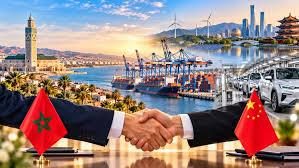
Morocco is stepping up its efforts to attract Chinese investment by presenting its industrial opportunities to around thirty companies from Zhejiang Province, one of China’s leading economic powerhouses. Automotive manufacturing, electronics, pharmaceuticals, industrial technologies, and renewable energy are among the sectors offering significant potential for new partnerships. This initiative reflects the Kingdom’s determination to strengthen its economic attractiveness and consolidate its position as an industrial and logistics hub connecting Europe, Africa, and Asia.
Morocco continues to diversify its international economic partnerships by strengthening its engagement with China’s major industrial regions. In Hangzhou, the capital of Zhejiang Province, a business meeting provided an opportunity to showcase the Kingdom’s investment prospects to approximately thirty Chinese companies operating across several strategic sectors.
Organized at the initiative of the China Council for the Promotion of International Trade, the meeting forms part of a broader effort to deepen economic relations between Rabat and Beijing. Its objective is to identify industrial projects, encourage productive investment, and develop stronger business complementarities between companies from both countries.
Addressing business representatives, Morocco’s Ambassador to China, Abdelkader El Ansari, highlighted the Kingdom’s competitive advantages, particularly its proximity to European markets, advanced port and logistics infrastructure, industrial zones, and reforms aimed at improving the business environment.
Morocco’s new Investment Charter also represents a key instrument in this strategy. It provides support mechanisms designed to facilitate business establishment, promote employment, and encourage investments that generate greater added value.
Zhejiang: An Industrial Partner with Significant Potential.
The choice of Zhejiang carries particular strategic importance. With a gross domestic product exceeding $1.32 trillion in 2025, the province ranks among China’s four largest regional economies. Its diversified industrial base, innovation capabilities, and entrepreneurial dynamism make it a particularly attractive partner for the development of Morocco’s industrial value chains.
The participating companies operate in automotive manufacturing, industrial equipment, electronics, pharmaceuticals, biotechnology, agribusiness, and renewable energy. These activities offer considerable complementarities with Morocco’s industrial priorities, as the Kingdom pursues a strategy focused on productive diversification and stronger export capabilities.
The automotive industry represents one of the most promising areas of cooperation. With annual production capacity exceeding one million vehicles and a network of more than 270 automotive suppliers, Morocco has developed an industrial ecosystem capable of attracting additional Chinese investment, particularly in electrical components, batteries, and mobility technologies.
Economic relations between Morocco and Zhejiang already rest on a substantial foundation. Approximately one hundred companies from the province maintain commercial ties with the Kingdom, while around twenty have invested in Morocco. Bilateral trade increased by 12% in 2025, with prospects for continued growth.
This cooperation has already taken concrete industrial form through the project developed by Chinese group Hailiang at Tanger Tech, focusing on copper processing. The investment illustrates Chinese manufacturers’ growing interest in Morocco’s production capabilities and their integration into international value chains.
Beyond attracting foreign capital, Morocco’s challenge is now to promote technology transfers, strengthen the participation of local suppliers, and establish sustainable industrial partnerships. The ability to turn these business meetings into concrete investments will ultimately determine the impact of this new phase of Sino-Moroccan economic cooperation.