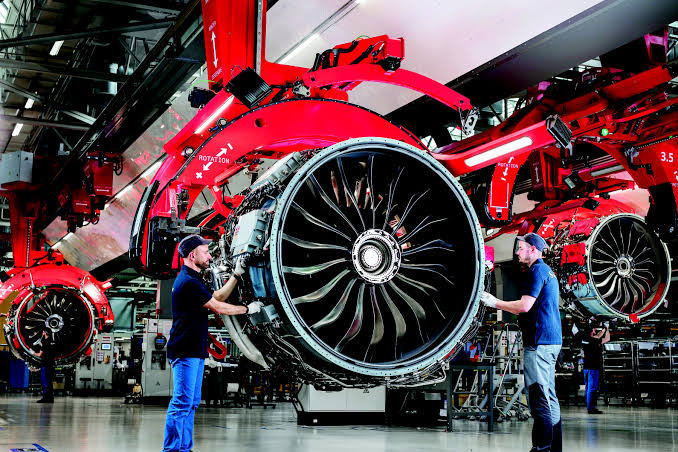
Morocco’s aerospace industry continues to expand with a new wave of industrial projects led by international groups. Safran, Matis Aerospace, APS Coating, Mecapole, and several partners specializing in aerospace technologies are planning to strengthen their manufacturing capabilities in the Kingdom. The announced investments exceed €500 million in total and cover component manufacturing, engine systems, surface treatment technologies, and sustainable aviation fuels. This momentum reinforces Morocco’s ambition to become a leading international aerospace manufacturing hub.
Morocco is steadily consolidating its position within global aerospace manufacturing supply chains. Having developed a competitive industrial ecosystem around wiring, machining, and component assembly, the Kingdom is now attracting investment in activities with higher technological added value.
The new projects announced by several international groups illustrate this evolution. They reflect manufacturers’ confidence in Morocco’s production capabilities, the quality of its infrastructure, and the availability of a structured industrial environment centered around specialized platforms, particularly Midparc in Nouaceur.
Among the planned investments is a project by Safran Oil Systems, which intends to allocate €11 million to the construction of a facility specializing in lubrication systems for aircraft engines. This activity represents an important technical segment of the aerospace value chain and could contribute to diversifying the industrial expertise developed locally.
Matis Aerospace, a joint venture involving Boeing and Safran Electrical & Power, is planning an investment of approximately $16.5 million in an aircraft electrical wiring manufacturing facility. The project is expected to create 750 direct jobs, further strengthening the sector’s contribution to skilled industrial employment.
APS Coating is also planning an €18 million investment in a factory specializing in aerospace component surface treatments, with 120 direct jobs announced. Meanwhile, Mecapole intends to develop precision machining capabilities for aircraft and helicopters through a project valued at €10 million, associated with the creation of 80 direct jobs.
Nouaceur: An Emerging Center of Industrial and Technological Excellence.
The concentration of these investments around Nouaceur confirms the strategic importance of this industrial platform for Morocco’s aerospace development. Its proximity to Mohammed V International Airport, the presence of international equipment manufacturers, and the availability of specialized infrastructure provide favorable conditions for establishing new production facilities.
This industrial momentum is accompanied by growing ambitions in research, innovation, and training. A consortium bringing together Boeing, Airbus, Lockheed Martin, Safran, OCP Group, and Mohammed VI Polytechnic University, among others, is planning the development of the Africa Centre for Manufacturing Excellence.
The initiative aims to strengthen capabilities in applied research, experimentation, and the industrialization of new aerospace manufacturing technologies. It could also help deepen cooperation between companies, training centers, and research institutions while encouraging the development of specialized expertise.
One of the most significant projects concerns sustainable aviation fuels. Green Sky Capital, a Qatar-based investment platform, plans to mobilize approximately €407.2 million for a production facility at Midparc, with an announced annual capacity of 200,000 tonnes.
This project could enable Morocco to establish a position in an emerging industrial segment driven by international efforts to decarbonize air transport. The initiative is associated with the potential creation of 4,000 direct and indirect jobs, subject to its implementation under the announced conditions.
The establishment of new technology-intensive activities represents a major challenge for Morocco’s domestic industry. Beyond increasing exports, the Kingdom aims to raise local industrial integration, develop supplier capabilities, and strengthen the participation of Moroccan companies in international aerospace programs.
This evolution also opens new opportunities for Moroccan small and medium-sized enterprises in specialized subcontracting, industrial services, maintenance, technical equipment, and engineering.
The central challenge will now be to transform this new wave of investment into a more integrated industrial ecosystem capable of generating greater domestic added value. Workforce development, technological innovation, and industrial diversification will determine Morocco’s ability to reach the next stage of aerospace development.
By attracting investment in engine systems, specialized components, and sustainable aviation fuels, Morocco is demonstrating a significant evolution in its industrial model: gradually moving from a competitive manufacturing platform toward an aerospace hub with greater technological capabilities, specialized expertise, and innovation capacity.